
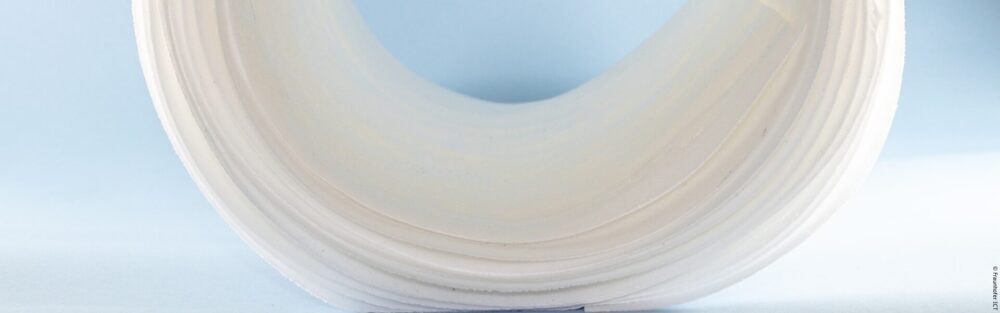
Bio-based plastics are particularly attractive for industrial applications when they can be integrated into existing production processes. This is precisely where the xPBS and xPBS Food projects, funded by the Fraunhofer Clusters of Excellence Circular Plastics Economy (CCPE), come in: The Fraunhofer Institutes ICT, IAP, IVV, and LBF are collaborating on the development and evaluation of the feasibility of a bio-based foam based on polybutylene succinate (PBS). The foam developed can be processed on existing extrusion lines.
In our interview, Anja Dennard from Fraunhofer ICT and Dr. Jens Balko from Fraunhofer IAP discuss the properties of xPBS, potential applications, and the next steps toward industrial implementation.
Processing on Existing Production Lines
What was the biggest challenge in developing PBS foam so that it could be processed on existing extrusion lines?
Anja Dennard: The property profile of PBS is generally well-suited for processing the polymer in the extrusion process without requiring any equipment modifications. In the foaming process, the biggest challenges are high melt strength combined with high elasticity. This requires either a material modification during synthesis or the addition of additives during processing.
Can xPBS already replace PE foams on a one-to-one basis, or are there still applications where that doesn’t work?
Dennard: PBS and PE have similar property profiles but are suited for different applications. PE is the standard plastic that has been technically refined over decades and is economically well-established. It is characterized by low cost, high availability, excellent chemical and moisture resistance, good long-term stability, and an established recycling infrastructure. Therefore, PE is particularly well-suited for durable packaging, technical molded parts, pipes, containers, and standard films.
“Mechanically, PBS is just as flexible and tough as PE, but at the same time it is somewhat more sensitive to long-term stress. Medium-density foams are very well suited for applications using PBS.”
Reuse and Safe Reprocessing
Jens Balko: Medium-density foams are very well suited for applications using PBS. The lowest foam densities still pose a challenge for PBS materials. We are working on that.
The applications for these foams range from engineering parts and profiles to packaging materials. PBS can be produced using entirely bio-based raw materials and is already available today. In addition, the raw materials can also be derived from agricultural and forestry residues or food waste. Therefore, if a customer needs a flexible, mass-market plastic with a reduced carbon footprint, PBS is the perfect choice. If the release of microplastics into the environment is to be reduced—though some loss into the environment cannot be avoided at all—the biodegradability of PBS plays a role. Compostable packaging and biodegradable single-use products are also of interest for certain applications.
Therefore, it is not technically possible to claim that one of the two materials is universally superior. The choice of material should be application-specific and take into account both processability and end-of-life requirements.
Is xPBS already price-competitive with PE foams?
Balko: Due to its higher price and lower market availability, PBS is currently not competitive with PE. But—and this is an important “but”—we are seeing increasing price volatility, rising prices, and a sharp rise in uncertainty regarding availability and supply for petroleum-based plastics such as PE. PBS, on the other hand, can be produced entirely from raw materials available in Europe. We have short, controlled, and secure supply chains. This provides security for the customer. Some companies have already recognized this advantage of PBS.
From Pilot Project to Industrial Application
Is xPBS already being utilized by companies in the field, and how would you assess its overall acceptance in the industry?
Balko: So far, we are not aware of any companies that have brought xPBS-based products to market. However, pilot projects are currently underway, and there is a great deal of interest in them. We at Fraunhofer are conducting these pilot studies—ideally in collaboration with the customer—to quickly scale up to industrial production.
In which area do you see the greatest short-term potential for xPBS to replace fossil-based foams?
Dennard: The future potential of PBS is seen primarily in applications where flexibility, toughness, and, in some cases, biodegradability are all required. However, for a broader market breakthrough, material costs must fall, industrial availability must increase, and processing windows—especially in the foam sector—must be further improved. PBS is therefore not a direct mass substitute for polyolefins, but a promising specialty material for sustainability-oriented applications.
Regarding the follow-up project xPBS-food: Why is a separate project necessary for this?
Dennard: Foam packaging that comes into contact with food is subject to stricter requirements in terms of safety, compliance, and sensory acceptance than foams used in non-food sectors such as construction, automotive, or leisure. This is particularly relevant for PBS when additives are used. The project and its development are still ongoing. The xPBS-food project addresses a particularly sensitive area of application that, due to the nature of the material, is very well suited for demonstration as a future use case.